


Atlas Infusions Full-Spectrum Collagen | 5 Types + HA + Biotin

Atlas Infusions Full-Spectrum Collagen – Structural Nutrition for Joints, Connective Tissue & Skin
Most collagen supplements are built for the beauty market — single-type collagen powders with a wellness aesthetic and cosmetic claims. Atlas Infusions Full-Spectrum Collagen is built for something different: biological function.
The human body contains multiple distinct types of collagen, each serving a specific structural role across different tissues — from the tensile strength of tendons and ligaments, to the cushioning of cartilage, to the elasticity of skin and fascia. A single-type collagen supplement addresses only a fraction of that system. Full-Spectrum Collagen addresses all of it.
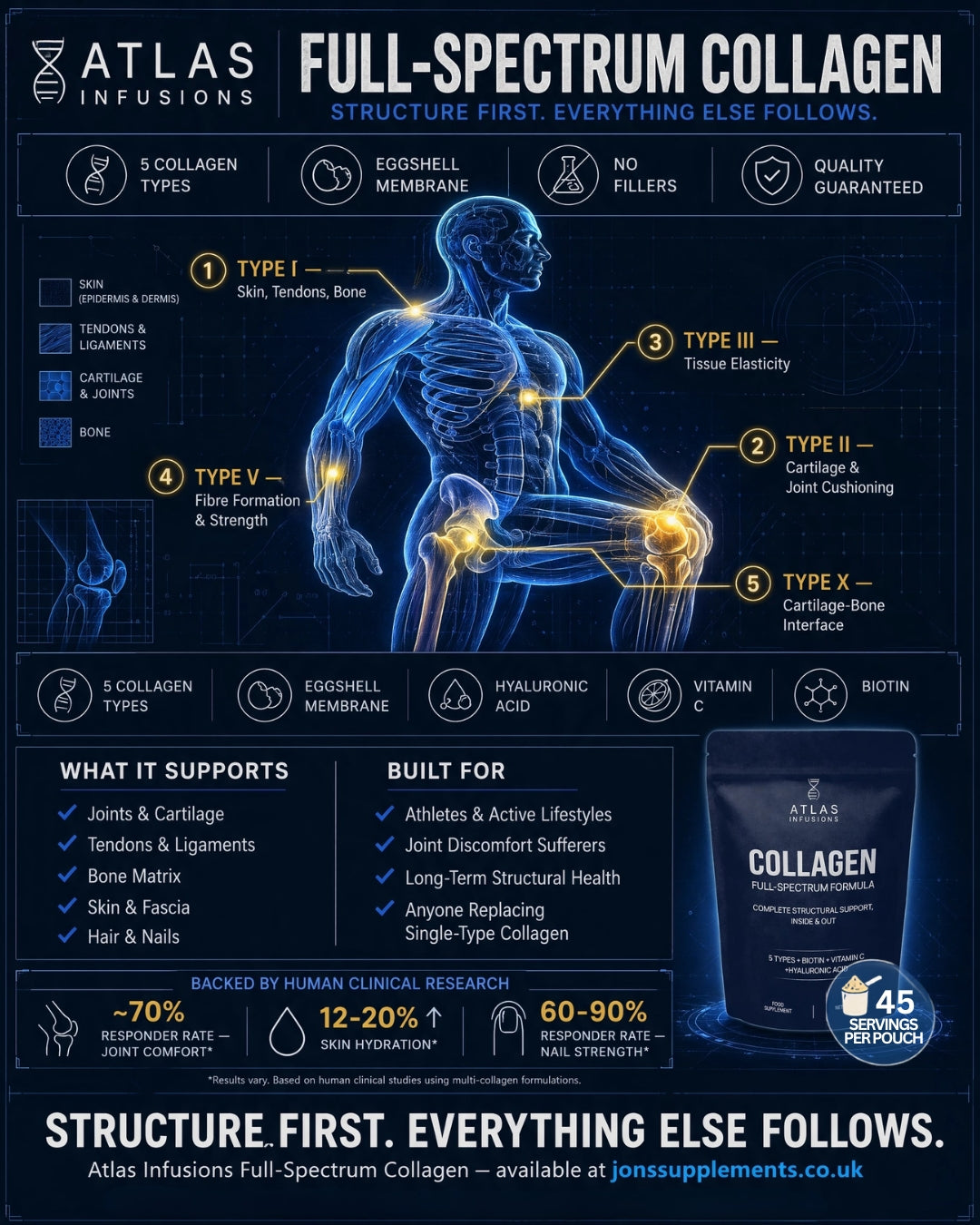
Delivering five collagen types (I, II, III, V, and X) alongside Hyaluronic Acid, Biotin, and Vitamin C — the essential cofactors for collagen synthesis and utilisation — this is a formula built for the structural layer of long-term health: joints, tendons, cartilage, fascia, connective tissue, and skin, supported comprehensively in a single, intelligent blend.
Function first. Aesthetics as a consequence.
The Five Collagen Types — Why They All Matter
Collagen is the most abundant protein in the human body, accounting for approximately one-third of total protein content. But collagen is not a single compound — it exists in at least 28 distinct types, each with a different molecular structure and a different primary role in the body's architecture. Most collagen supplements include only Type I, and occasionally Type III. Full-Spectrum Collagen covers the five most structurally significant types:
Type I — Skin, Tendons, Ligaments & Bone
The most abundant collagen in the human body, Type I forms the primary structural matrix of skin, tendons, ligaments, and bones. It provides the tensile strength and structural integrity that allows these tissues to bear load, resist deformation, and recover from mechanical stress. Declining Type I collagen is the primary driver of skin thinning, wrinkle formation, tendon vulnerability, and reduced bone matrix density as we age.
Type II — Cartilage & Joint Cushioning
Type II collagen is the primary component of hyaline cartilage — the smooth tissue that covers the surfaces of joints and provides the cushioning and shock absorption that allows pain-free movement. It is structurally distinct from Type I, comprising a looser fibril network designed to retain water and resist compressive forces. Research on hydrolysed Type II collagen supplementation has consistently demonstrated reductions in joint discomfort and improvements in mobility, particularly in individuals with exercise-induced or age-related joint degeneration.
Type III — Tissue Elasticity & Resilience
Often found alongside Type I collagen, Type III forms the structural framework of soft tissues including the skin dermis, blood vessel walls, and internal organs. It contributes the elastic, pliable quality to tissues — the ability to deform under load and return to shape. Type III collagen is particularly abundant in younger tissue and declines with age, contributing to reduced skin elasticity and tissue resilience.
Type V — Collagen Fibre Formation Regulation
Type V collagen plays a less celebrated but critically important regulatory role — it controls the diameter and organisation of collagen fibres during synthesis. Without adequate Type V collagen, the fibrillar structure of Types I and III collagen is disorganised and weaker. By including Type V, Full-Spectrum Collagen supports not just the quantity of collagen in the system, but the quality and structural integrity of the fibres themselves.
Type X — Cartilage-Bone Interface & Joint Longevity
Type X collagen is found specifically at the interface between cartilage and bone — a region under particularly high mechanical stress during movement, exercise, and load-bearing activity. It plays an important role in the calcification of cartilage and the maintenance of the subchondral bone structure that supports the cartilage layer above it. Its inclusion in the formula reflects a commitment to comprehensive joint health support rather than superficial cartilage coverage.
The Supporting Ingredient Complex
Vitamin C — The Essential Collagen Cofactor
Vitamin C is not optional in a collagen formula — it is biochemically essential. Collagen synthesis requires hydroxylation of proline and lysine residues, a process catalysed by enzymes that are entirely dependent on Vitamin C as a cofactor. Without adequate Vitamin C, new collagen fibres cannot be properly cross-linked and stabilised, significantly reducing the structural strength of any new collagen synthesised. Supplementing collagen without Vitamin C is genuinely less effective than supplementing the combination. At the doses used in clinical research (80–500mg/day), Vitamin C also contributes meaningful antioxidant protection to the tissues undergoing repair and remodelling.
Hyaluronic Acid — Joint Lubrication & Tissue Hydration
Hyaluronic Acid (HA) is a naturally occurring glycosaminoglycan found in particularly high concentrations in synovial joint fluid, the vitreous humour of the eye, and the dermal layer of the skin. Its primary role is water retention — HA can hold up to 1,000 times its own weight in water — which makes it the primary mechanism behind joint lubrication, shock absorption, and the hydrated, plump quality of healthy skin and fascia.
Clinical research at doses of 120–240mg/day has demonstrated improvements of approximately 12–20% in skin hydration alongside meaningful improvements in joint comfort and mobility — making HA a genuinely functional addition to this formula rather than a cosmetic one.
Biotin — Keratin Production & Structural Tissue Support
Biotin (Vitamin B7) is a water-soluble B-vitamin that plays a central role in the synthesis of keratin — the structural protein that makes up hair, nails, and the outer layers of skin. Clinical research at doses of 2.5–7.5mg/day has demonstrated meaningful improvements in nail thickness and reduced splitting (60–90% responder rate), alongside reductions in hair breakage. Biotin also supports the amino acid utilisation processes that underpin new tissue growth, making it a functional cofactor for the broader connective tissue repair goals of this formula.
The Eggshell Membrane Difference
Beyond the standard collagen peptide matrix, Full-Spectrum Collagen includes eggshell membrane — a specialised natural source uniquely rich in collagen-associated structural compounds including naturally occurring Type I, V, and X collagen, elastin, glycosaminoglycans, and hyaluronic acid in their native, structurally integrated forms.
Research specifically on eggshell membrane supplementation has demonstrated improvements in joint discomfort, flexibility, and connective tissue resilience — benefits attributed to the combination of multiple bioactive compounds acting synergistically in their natural matrix rather than as isolated extracts. Its inclusion elevates Full-Spectrum Collagen beyond a standard peptide formula into genuinely comprehensive structural nutrition.
Tendon, Ligament & Connective Tissue Resilience
Types I, III, and V collagen provide the primary structural matrix for tendons, ligaments, and fascia — the connective tissues most commonly strained through athletic training, repetitive movement, or inadequate recovery. Supporting these tissues nutritionally helps maintain their load-bearing capacity and resilience, reducing the risk of injury and improving recovery from connective tissue stress.
Skin Elasticity & Hydration
While Full-Spectrum Collagen is built for biological function rather than cosmetic trends, skin benefits are a natural downstream consequence of supporting the dermis with Types I and III collagen and Hyaluronic Acid. Research consistently demonstrates improvements in skin elasticity, hydration, and the reduction of fine lines with consistent collagen peptide and HA supplementation — occurring as the structural matrix of the dermis is progressively supported over time.
Bone Matrix Support
Type I collagen forms the organic framework of bone — the matrix into which calcium and other minerals are deposited to create the composite structure that gives bone its combination of strength and flexibility. Supporting Type I collagen synthesis contributes to the maintenance of healthy bone matrix, particularly relevant for active individuals and those concerned with long-term skeletal health.
Why Choose Atlas Infusions Full-Spectrum Collagen?
- Five collagen types (I, II, III, V & X) — comprehensive structural coverage that single-type supplements cannot provide
- Targets joints, cartilage, tendons, ligaments, fascia, bone, and skin — the complete structural system
- Eggshell membrane included — a unique, multi-compound connective tissue source beyond standard peptide blends
- Vitamin C included — the biochemically essential cofactor for collagen synthesis and fibre cross-linking
- Hyaluronic Acid included — for joint lubrication, shock absorption, and tissue hydration
- Biotin at a functional dose — for keratin production, nail integrity, and hair strength
- Built for biological function, not cosmetic trends — structure and resilience first, aesthetics as a consequence
- No stimulants, no fillers, no decorative ingredients — every ingredient serves a clear biological purpose
- Designed for long-term, daily use — benefits compound with consistency over 3–6 months
- Part of the Atlas Infusions biological system — works synergistically alongside IGG-1 and SLU-PP332 for comprehensive health optimisation
Evidence data sourced from peer-reviewed human clinical research. Individual results may vary. Benefits are cumulative and build with consistent daily supplementation over time.
Who Is It For?
Atlas Infusions Full-Spectrum Collagen is ideal for:
- Athletes and active individuals looking to protect and support joints, tendons, and connective tissue under the demands of regular training
- Those experiencing joint discomfort, reduced flexibility, or connective tissue strain from exercise, age, or occupation
- Anyone who wants comprehensive structural nutrition in a single product rather than multiple separate collagen, joint, and skin supplements
- People focused on long-term joint health and longevity who want to invest in their structural foundation before problems develop
- Those who have been using single-type collagen supplements and want broader, more complete tissue coverage
- Anyone serious about long-term biological resilience rather than short-term cosmetic results
- Those building a comprehensive Atlas Infusions health system alongside IGG-1 and SLU-PP332
The Result
Stronger joints. More resilient connective tissue. Better cartilage cushioning. Healthier tendons and ligaments. And as a downstream consequence of all of that — healthier, more elastic skin and stronger hair and nails.
Full-Spectrum Collagen doesn't promise cosmetic transformation. It delivers something more valuable: the structural foundation your body needs to move well, recover properly, and age with resilience.
Structure first. Everything else follows.
Exact gram doses per serving are not published by Atlas Infusions. All ingredients are formulated within the dose ranges associated with clinical efficacy in human research. Refer to the product label for the complete supplement facts panel.
Key Benefits
How To Use
Detailed Breakdown
| Typical Values | Per Serving | %ADV |
|---|---|---|
| Energy | 40 kcal | |
| Protein | 10g | 20% |
| Fat | 0g | |
| Carbohydrates | <1g | |
| Salt | 44mg | 2% |
| Proprietary Blend | 10,880mg | ** |
|---|---|---|
| Atlas Collagen Blend | ||
| Bovine Collagen | ||
| Marine Collagen | ||
| Avian Collagen | ||
| Egg-shell Membrane Collagen | ||
| Hyaluronic Acid | 55mg | ** |
| Vitamin C (as Ascorbic Acid) | 55mg | 61% |
| Biotin (as d-Biotin) | 2470mcg | 8,233% |
| ++Percent daily Values are based on a 2000 calorie diet |
|---|
| Daily values no established. |
Ingredients
Allergen Information
Complete Your Stack
Popular picks that go well with this


Delivery & Returns
Free UK delivery on orders over £90. Code FREESHIP
Standard delivery £3.99. Next day delivery with DPD £5.75.
Returns accepted within 21 days.
